An atlas instead of a mannequin
The first version generated the body from ellipsoids. Real organs and bones needed an atlas, so the check whether a point is inside the body became a volume baked from the meshes.
A human body from anatomical atlases, with a circulatory system grown by an algorithm
A human body in the browser: the skeleton, the organs and the main vessels come from open anatomical atlases, and the small vessels that reach every organ are grown by an algorithm when the page loads. A pulse wave travels from the heart through 86,565 segments.
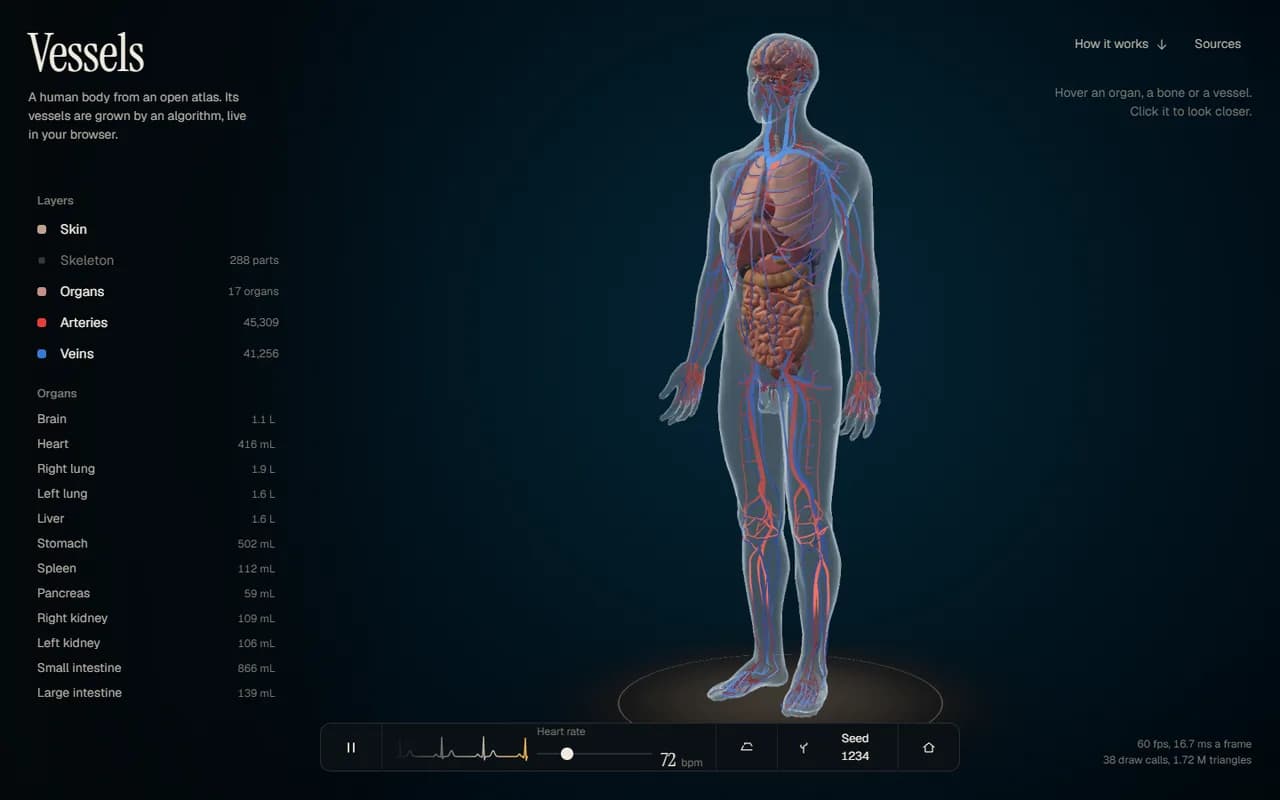
I wanted to combine real anatomical data with geometry generated on the fly and see how much a browser can draw smoothly. A circulatory system is a good test: tens of thousands of thin tubes that have to stay inside organs and steer around bones.
The first version generated the body from ellipsoids. Real organs and bones needed an atlas, so the check whether a point is inside the body became a volume baked from the meshes.
Each vessel tree is one geometry with one instance per segment. Hover renders ids into a 1 x 1 pixel target, so 300k triangles per layer need no BVH.
65 tests guard Murray's law at every node, determinism per seed, branches never leaving an organ and the direction of the pulse wave. A script breaks the code in 20 places, and each one has to turn a test red.