My own CRDT instead of a library
An insert names the character it follows, so colliding edits keep their intent. Concurrent inserts in one spot are ordered by the Lamport counter, and ties by the device id.
Shared editing that survives a broken network
A collaboration engine, the kind behind Google Docs or Figma, written from scratch. A laptop, a phone and a tablet edit one list over a network you can slow down, break and cut with scissors. The text merges with a CRDT, no Yjs and no Automerge.
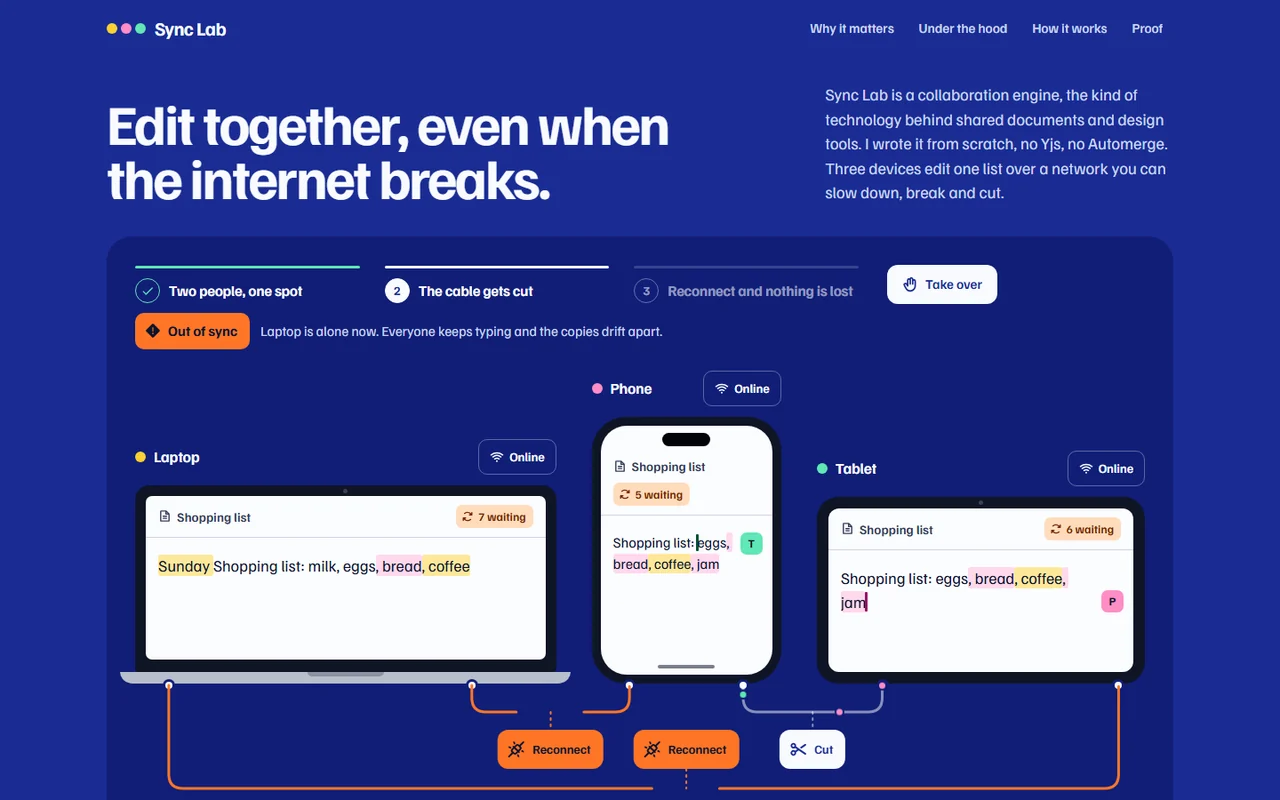
Shared editing looks simple until two people type in the same spot while packets get lost. I wanted to write the merging myself and prove that every copy always ends up with the same text.
An insert names the character it follows, so colliding edits keep their intent. Concurrent inserts in one spot are ordered by the Lamport counter, and ties by the device id.
fast-check generates thousands of random edit histories delivered in random order with duplicates. Every copy has to end identical, and an insert between two characters has to stay between them.
A script removes the device id tie-break. The convergence test fails at once and shrinks the case to two edits: Laptop types L, Phone types P, and the copies end up as PL and LP. Then the script restores the file and checks its hash.